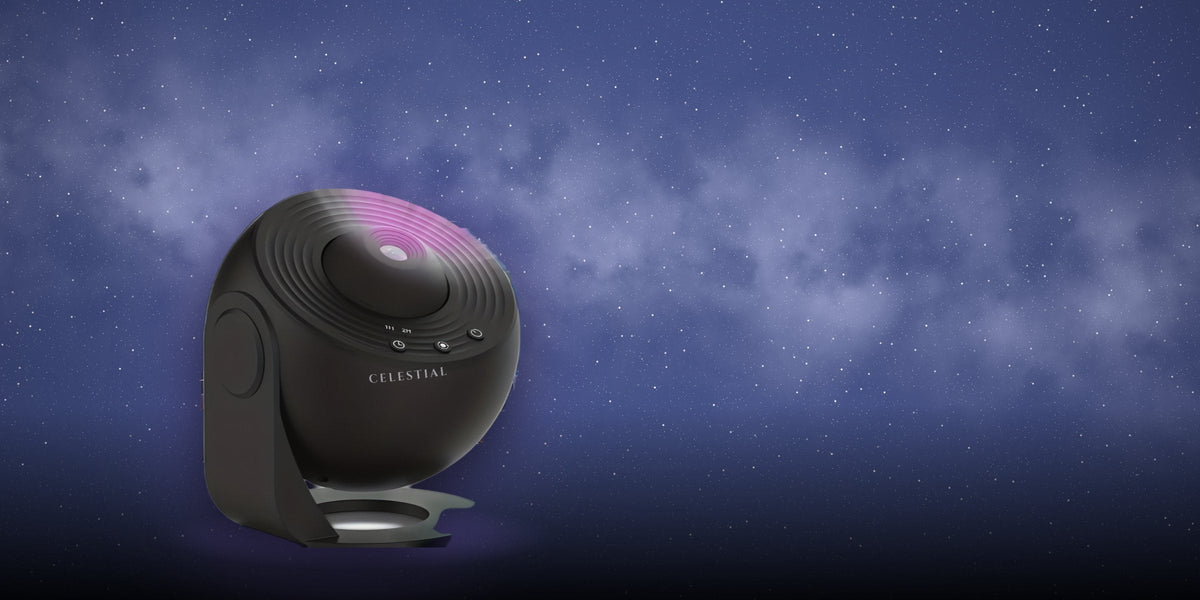
Not every family lives near a science museum, and even the ones that do cannot exactly visit every week. A home planetarium projector solves a smaller version of that problem: it brings a version of the dome experience, constellations, planets, and moving night sky, straight into a bedroom or living room, on a school night, with no admission ticket required. It has become a popular pick for homeschool families, curious kids, and honestly a fair number of adults who just never lost interest in space. This guide covers what makes a projector genuinely useful for learning, not just for looks, and how to choose one that actually holds up as an educational tool.
Quick Answer: What Is a Home Planetarium Projector Used For?
A home planetarium projector is used to display stars, constellations, and sometimes planets on a ceiling or wall for astronomy learning and casual stargazing indoors. Unlike a purely decorative galaxy projector, a home planetarium projector typically includes interchangeable discs or accurate star charts, making it useful for teaching kids about the night sky, seasons, and basic astronomy without needing a telescope or clear weather.
Why Bring a Planetarium Experience Home
Museum planetariums work because they turn an abstract topic, the scale and layout of the night sky, into something you can actually see and point at. A home planetarium projector borrows that same idea at a much smaller scale. Instead of reading about the Big Dipper in a book, a kid can look up and find it projected right above their bed, which tends to make the information stick a lot better than a diagram ever could.
If you are comparing this to a simpler decorative option, our guide on What Is a Galaxy Projector? covers the basics of the wider product category before we get into the education focused side of it here.
What Makes a Projector Educational Rather Than Just Decorative
Accurate Star and Constellation Patterns
This is the biggest difference between a toy style star projector and a genuine home planetarium projector. Educational models are designed to reflect real constellation shapes and star positions rather than a random scattering of dots, which matters if the goal is actually teaching someone to recognize the night sky rather than just decorating a ceiling.
Interchangeable Discs or Star Charts
Many home planetarium projectors come with multiple discs covering different constellations, planets, or seasonal sky views, letting a family rotate through different lessons instead of staring at the same fixed pattern every night. This is one of the clearest signs a projector was built with learning in mind rather than pure ambiance.
For a closer look at the technology behind discs, lenses, and how the image actually gets projected, see How Does a Galaxy Projector Work?.
Labeling and Reference Material
Some models come with a printed star chart, booklet, or app that identifies what is actually being projected. This matters more than it might seem, since a beautiful but unlabeled star field does not teach much on its own. A projector paired with even a basic reference guide turns passive viewing into an actual lesson.
Choosing the Right Home Planetarium Projector for Learning
A few features are worth prioritizing if education, not just aesthetics, is the main goal. Look for a model with several discs rather than just one, since variety is what keeps kids engaged over time. Check whether the discs are labeled or accompanied by any reference material identifying constellations by name. And consider brightness and image sharpness, since a blurry or overly dim projection makes it much harder to actually pick out individual stars and shapes.
For a full breakdown of features to compare before buying, our Galaxy Projector Buying Guide walks through the details, and if this is specifically for a child's room, Best Galaxy Projector for Kids' Bedroom in 2026 covers age appropriate features and safety considerations.
Getting the Most Out of It as a Learning Tool
A home planetarium projector works best when it is used a little more intentionally than just background lighting. Try picking one constellation or disc per session and actually naming it out loud, rather than leaving it running on a random rotation every night. Pairing it with a simple star chart app or a library book on astronomy adds context that the projector alone cannot provide. And using it consistently, even just a few minutes before bed, tends to build familiarity with the night sky faster than an occasional novelty session.
It is also worth comparing this to a basic night light if your household is trying to decide between the two. Our guide on Galaxy Projector vs Regular Night Light: Which Is Better for Kids? breaks down the differences in more depth.
Common Mistakes to Avoid
A few habits tend to undercut the educational value of these projectors. Leaving it on a random auto-rotating mode without ever naming what is being shown turns it into background noise rather than a lesson. Using it in a room that is too bright washes out fainter stars, making it harder to distinguish real patterns. Skipping the included reference material, if the model comes with one, misses most of the actual teaching value. And placing it too close to a textured ceiling can distort the pattern enough that constellations become difficult to recognize.
Who Benefits Most
This style of projector tends to matter most for homeschool families looking for a hands on way to cover basic astronomy, elementary and middle school aged kids working on space or science units at school, and families who simply enjoy stargazing but do not always have clear skies or dark enough surroundings to see much from their yard. Younger toddlers may enjoy the visuals without engaging much with the educational side yet, which is fine, the learning angle tends to click more with kids around school age and up.
Why Trust This Guide
This guide draws on comparing the educational features of multiple planetarium style projectors, general astronomy education resources used in classrooms and homeschool settings, and common feedback from families about which features actually get used for learning versus which ones mostly sit unused. It is meant as practical shopping and usage guidance, not a substitute for a structured astronomy curriculum.
Frequently Asked Questions
What age is a home planetarium projector appropriate for?
Most models work well for kids around three and up, though the educational value tends to click more with school aged children who are old enough to name and remember constellations. Check the specific product's recommended age range before buying.
How is a home planetarium projector different from a regular star projector?
A regular star projector is usually decorative, with a scattered or randomly generated star pattern. A home planetarium projector is designed to reflect accurate constellations and often includes multiple discs or reference material meant for learning rather than just ambiance.
Do the projected stars need to match the real night sky exactly?
Good models aim for scientifically accurate constellation shapes, though the projected sky is generally a representative view rather than a live, date and location specific map like a planetarium app would show.
Can this replace an actual telescope for learning astronomy?
Not exactly. A home planetarium projector is better suited to learning constellation shapes and basic sky literacy indoors, while a telescope is for observing real objects like the moon or planets outdoors. Many families use both together.
Does the room need to be completely dark to see the projection clearly?
Not completely, but a dim or dark room makes fainter stars and details much easier to see. A fully lit room will wash out most of the projection.
Is a home planetarium projector worth it compared to visiting an actual planetarium?
They serve different purposes rather than directly competing. A real planetarium offers a bigger, guided, one time experience, while a home projector offers repeated, low cost exposure to the night sky on an ordinary night, which can build familiarity over time in a way an occasional museum trip cannot.
Final Thoughts
A home planetarium projector earns its place as an actual learning tool when it is chosen for accuracy and variety, not just visuals, and used a little intentionally rather than left running as background light. For families short on planetarium visits or clear night skies, it is a simple, low pressure way to build some real familiarity with the stars.
If you are ready to bring this into your home, take a look at the Planetarium Projector Night Light with 12 Discs, or browse our full galaxy projector collection to compare models based on disc variety, brightness, and how your family plans to use it.