A soft sky on the nursery ceiling can make those late-night feeds a little gentler, for you as much as the baby. But a nursery is a room where details matter. Where the projector sits, which color it glows, how long it runs, and where the cord goes are all worth thinking through before the first night.
This guide covers how to set up a star projector in a nursery calmly and safely. It isn't medical advice: if you have questions about your baby's sleep, your pediatrician is the right person to ask.
Key takeaways
- A projector is an extra, never part of the sleep space: nothing goes in or on the crib, and the crib stays clear.
- Place the projector across the room, out of reach, with its cord well away from the crib; a common guideline is at least 3 feet.
- Choose dim, warm colors for nighttime, and aim the light at the ceiling, never toward the baby's face.
- Use the auto-off timer so the projector is part of the bedtime routine rather than running all night.
- Store remotes out of reach, as many use coin batteries, and ask your pediatrician about any sleep concerns.
Safe-sleep basics first
Before talking about projectors, it's worth restating the foundation. Standard safe-sleep guidance for infants centers on a firm, flat sleep surface and a crib kept clear of loose items. Your pediatrician can walk you through the current recommendations for your baby.
A projector sits outside that space. It's mood lighting for the room, not a crib accessory. That means:
- Never place a projector, night light, or remote in the crib or clip it to the crib rails.
- Don't rest it on a shelf directly above the crib, where it could fall in.
- Keep the crib clear of the projector's cable entirely.
With that settled, the rest is about making the light pleasant and the setup tidy.
Where to put it
The best spot is usually a dresser, changing table, or sturdy shelf on the far side of the room from the crib. Aim the projector at the ceiling so the pattern spreads overhead.
Out of reach, now and later
A newborn can't reach anything, but a baby who pulls up in the crib can reach a surprising distance, and a toddler can climb. Choose a spot that will still be out of reach a year from now. High shelves and the back of a tall dresser work well. The front edge of a low table does not.
Mind the distance to the ceiling
As a rule of thumb, most projectors look best roughly 5 to 10 feet from the surface they're lighting. A dresser in a standard nursery usually puts the projector in that range. A closer, smaller pattern tends to look brighter, so if the effect feels intense, moving the projector farther away softens it. For more on getting distance and angle right, see our guide on how to set up a star projector.
Keep it stable and ventilated
Place the projector on a flat surface where it can't be knocked off by a swinging door or a curious pet. Don't cover it with a blanket or muslin to dim it; use the brightness setting instead, and give it a little space around it.

Light color and brightness
For nighttime, dim and warm is the usual advice. Many parents find soft amber, orange, or red tones feel calmer at night than bright white or vivid blue, and a low brightness keeps the room restful.
- Start dim. The nursery only needs enough light to set a mood and let you see the outline of the room.
- Pick one steady color. Save color-cycling modes for daytime play, if you use them at all.
- Use slow motion only. A slow drift of stars is soothing; fast rotation is not what you want at 2 a.m.
- Aim at the ceiling, not the crib. The light should land overhead, not shine toward the baby's face.
A word on lasers
Some star projectors use small lasers to create sharp star points. Never look directly into the lens, and position the projector so the beam path can't reach the baby's eyes, even when the baby is held or sitting up. Our eye safety guide explains laser classes and what they mean in practice. If you'd rather avoid lasers altogether in the nursery, an LED projector or a glowing moon lamp is a simple alternative; our laser vs LED comparison covers the difference.
Timers and routines
A projector works best as one step in a predictable bedtime routine, not as an all-night fixture. A typical sequence might be bath, feed, a song or story, then lights down and the projector on.
The timer is the key feature. Many projectors have an auto-off setting; use it so the light fades out on its own after your baby settles. Check your model's manual for the available timer lengths.
Tip: For night feeds, consider a separate dim night light on the far side of the room. The projector can stay off, and you can still see what you're doing without switching on the overhead light.
Wondering whether a projector or a plain night light is the better fit? Our comparison of galaxy projectors vs regular night lights for kids weighs the options.
Cords and batteries
Cords and small batteries are the details most worth getting right.
Cords
- Keep every cord out of reach of the crib. A widely shared guideline for corded devices like baby monitors is at least 3 feet away, and the same logic applies to projectors.
- Run cables behind furniture and secure them with cable clips or a cord cover along the wall.
- Don't leave slack loops hanging down the back of the dresser where a crawling baby could grab them.
- Plug into an outlet behind furniture where possible, and use outlet covers on unused sockets.
Batteries and remotes
Remote controls, and some small lamps, often use coin or button batteries. These are a serious hazard if swallowed. Keep remotes on a high shelf, check that battery compartments are closed securely, and dispose of old batteries promptly. If you ever suspect a child has swallowed a battery, seek emergency medical care immediately.
Battery-powered lamps, like our Mini 3D Moon Lamp, are handy because there's no cord at all. Just keep them out of reach, too, and check the battery cover regularly.
Choosing a projector
Look for features that make a calm, hands-off setup easy.
| Feature | Why it matters in a nursery |
|---|---|
| Auto-off timer | Fits a routine; avoids running all night |
| Adjustable brightness | Keeps the room dim and restful |
| Warm color options | Soft amber or red tones for nighttime |
| Slow or no rotation | Gentle motion rather than a busy display |
| Stable base | Less likely to tip on a dresser or shelf |
| Remote (stored out of reach) | Adjust without walking over and disturbing the baby |
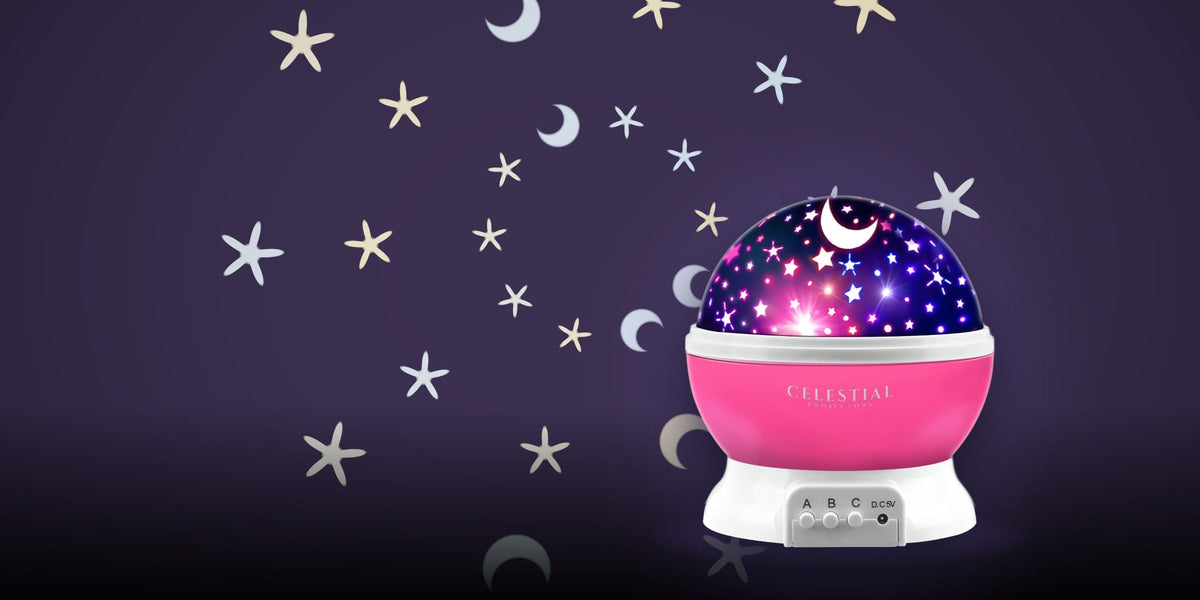
From our range, the Rotating Star & Moon Projector is a natural nursery choice: familiar stars and moons with gentle rotation. For a glow rather than a projection, the Galaxy Moon Lamp makes a lovely, soft night light and comes with a remote, so you can dim it from the glider.

Browse the star projectors for kids and moon lamps collections for more options. Our moon lamp buying guide can help if you're leaning toward a glow.
A note on fiber optic lamps: their glowing strands are fun for older children, but they're easy for little hands to pull. Keep them out of the nursery or well out of reach.
As your baby grows
The nursery setup will change as your child does. Toddlers often want a say in the lights, and a projector they can "help" switch on becomes part of the bedtime ritual. Keep the controls with you, but let them choose the color.
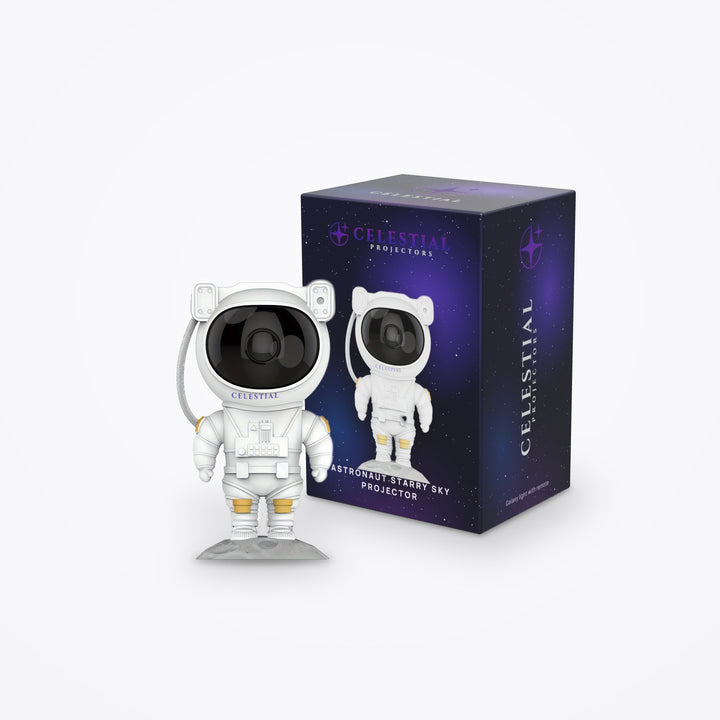
By preschool age, many kids want a projector that feels like theirs. A space-themed character such as the Astronaut Galaxy Light Projector can become a favorite bedroom companion. Our astronaut projector guide compares the models, and our guide to the best galaxy projector for a kid's bedroom covers what changes as children get older.

Quick setup checklist
Before the first night, run through this list. It takes five minutes and covers the details that matter most.
- The crib is clear, and nothing light-related is in it, on it, or above it.
- The projector sits on a stable surface across the room, out of reach of a standing toddler.
- The cord runs behind furniture, is secured along the wall, and stays well away from the crib.
- The remote has a home on a high shelf, and its battery cover is closed tight.
- The projector is set to a dim, warm, steady color with slow or no rotation.
- The beam lands on the ceiling, and you've checked it from the crib's position and from the glider.
- The auto-off timer is set, if your model has one.
- There's a separate dim light for night feeds, so you don't have to switch on the overhead light.
Recheck the list every few months. Babies grow quickly, and a spot that was out of reach in spring may not be by fall. Rooms change too: a new chair or a moved dresser can put a cord or a beam somewhere it shouldn't be.
FAQ
Is a star projector safe for a baby's nursery?
It can be part of a calm nursery when set up thoughtfully: placed across the room and out of reach, with cords well away from the crib, dim warm light aimed at the ceiling, and a timer. Never put a projector in or on the crib. Ask your pediatrician if you have questions about your baby's sleep.
What color light is best for a nursery at night?
Many parents prefer dim, warm tones such as amber, orange, or soft red at night, and find bright white or vivid blue more stimulating. Keep the brightness low whichever color you choose.
Should a projector stay on all night in the nursery?
Most parents use it during the bedtime routine and let the auto-off timer switch it off. If you need light for night feeds, a separate dim night light across the room usually works better than leaving a projector running.
How far should the projector cord be from the crib?
A widely shared guideline for corded devices such as baby monitors is at least 3 feet from the crib. Route the cord behind furniture and secure it so there are no loose loops a baby could reach.
Can a star projector help my baby sleep?
Some parents find a soft projection is a pleasant cue in a bedtime routine, but every baby is different and a projector isn't a sleep aid. For any concerns about your baby's sleep, talk to your pediatrician.