Shop for bedroom lighting long enough and the labels start to blur. One listing says "starlight projector," another says "galaxy projector," a third calls itself a "star night light," and they can look nearly identical in a thumbnail. They aren't the same thing, and the difference shows up the moment you switch off the lamp.
Here is what each category actually does, how they compare in a real room, and how to tell which one you want before you buy.
Key takeaways
- A starlight projector throws sharp points of light, like stars, across a ceiling or wall.
- A galaxy projector adds soft, colored nebula clouds behind the stars for a fuller, moodier sky.
- A night light glows in place and lights the room gently; it doesn't project a pattern.
- Hybrids exist: aurora, ocean wave, and planetarium projectors each sit somewhere between these three.
- Choose by what you want to see overhead and how much light you want in the room, not by the label.
The short answer
Think of it as a question of where the light ends up.
- Starlight projector: the light lands on your ceiling as a scatter of distinct points. The room itself stays fairly dark.
- Galaxy projector: the light lands on your ceiling as stars plus broad washes of color. The room gets a noticeable colored glow.
- Night light: the light stays on or near the device. It brightens the area around it so you can see your way to the door.
Everything else is detail. But the details decide whether you love it or return it, so let's go through them.
What a starlight projector does
A starlight projector is the simplest of the projecting types. A light source, either a small laser or an LED, shines through an optic that splits it into many tiny points. Point it at a ceiling and you get a field of stars. Many models rotate the pattern slowly so the stars drift.
Where it shines
Starlight projectors suit people who want the feeling of a night sky without much color. Because the pattern is mostly dark space between points, they add very little overall light to a room. That makes them a good match for light sleepers who still want something to look at, and for compact spaces such as a car interior. Our USB Star Projector is a good example: it's tiny, plugs into a USB port, and works on a car roof or a bedroom ceiling.
Limitations
On their own, star points can look sparse on a large or very textured ceiling. They also tend to be monochrome or limited to a few colors. If you want drama, you'll probably want a galaxy projector instead.
One note on lasers: if a starlight projector uses one, never look directly into the lens. Our explainer on laser vs LED star projectors covers the trade-offs, and our eye safety guide explains laser classes in plain English.
What a galaxy projector does
A galaxy projector takes the star pattern and adds a second layer: soft clouds of color meant to look like a nebula. The clouds usually come from a colored LED shining through a textured lens, while the stars come from a separate laser or LED. The two layers combine into something closer to a long-exposure space photograph than a real night sky.

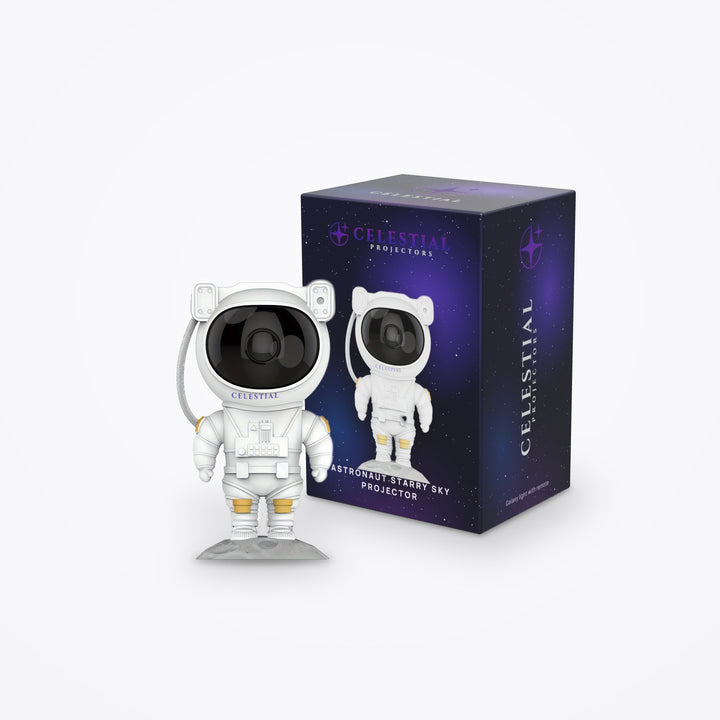
Galaxy projectors are the most popular category for a reason. They transform a plain room quickly, and most offer several color combinations, brightness levels, and a rotation setting. The Galaxy Star Projector with Remote is a typical example, with nebula and star layers you can control from bed.
The trade-offs
Galaxy projectors put more light into a room than starlight projectors. For a wind-down routine that's usually fine, but some people find a bright, saturated nebula too stimulating at bedtime. Look for adjustable brightness and an auto-off timer. And understand that a galaxy projector paints an impression of space; it doesn't show real constellations. If accuracy matters, read on to the planetarium section.
New to the category? Our beginner's guide to galaxy projectors covers the basics, and you can compare models in the galaxy projectors collection.
What a night light does
A night light's job is practical: give off enough low, steady light that you can find the bathroom, check on a baby, or reassure a child who doesn't like the dark. It glows from the device itself rather than throwing a pattern across the room.
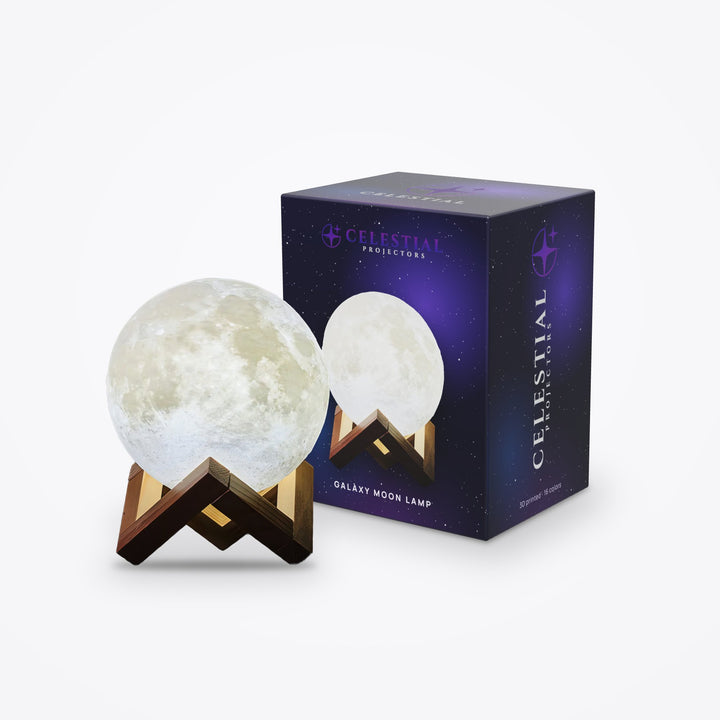
Modern night lights are much more interesting to look at than the plug-in shells of the past. A moon lamp, for instance, is a night light in the shape of the moon. The Galaxy Moon Lamp uses a 3D-printed surface that glows from within, and it comes with a remote. Fiber optic lamps, like our Fiber Optic Sensory Lamp, are another variation: dozens of glowing strands that shift color.

Why choose a night light
Night lights put light where you need it: on the floor, the doorway, and the furniture. Projectors put light on the ceiling, which looks great but doesn't help much when you're trying not to step on a toy at 3 a.m. Night lights also tend to be the simplest to live with, with no aiming or focusing. For more on choosing one, our moon lamp buying guide is a good place to start.
Side-by-side comparison
| Starlight projector | Galaxy projector | Night light | |
|---|---|---|---|
| What you see | Points of light on ceiling or walls | Stars plus colored nebula clouds | A glowing object |
| Light added to the room | Low | Moderate | Low to moderate, near the device |
| Helps you see in the dark | A little | Somewhat | Yes, that's its job |
| Setup | Aim it | Aim it, choose modes | Place it |
| Typical motion | Slow rotation | Rotation, color shifts | Usually static or slow color change |
| Best for | Subtle ambiance, small spaces | Mood lighting, wind-down | Nurseries, hallways, young kids |
| Examples in our range | USB Star Projector ($7.99) | Galaxy Star Projector ($29.99) | Galaxy Moon Lamp ($36.99) |
Where the hybrids fit
A lot of popular lights don't fit neatly into one box. Here's where they sit.
Aurora projectors
These project wide, slow-moving bands of color, inspired by the northern lights, instead of star points. They behave like galaxy projectors in how much light they add, but the effect is calmer and more fluid. See the Northern Lights Projector or our aurora projector guide.
Ocean wave projectors
These create a rippling, underwater light pattern. Some, like the Starry Night Light Projector, combine stars and water ripples in one unit. Our new ocean wave projector guide explains how the effect works.
Planetarium projectors
These are starlight projectors with ambition. Instead of a random pattern, they project real constellations from interchangeable discs, so the stars on your ceiling match the sky outside. The Planetarium Star Projector with 12 Discs is our pick. For a deeper comparison, read planetarium vs galaxy projectors.

Reading a product listing
Labels online are loose, so it helps to know what to look for beyond the title.
- Look at photos taken with the lights off. If every image shows a glowing device on a table, it's probably a night light. If the images show patterns on a ceiling, it's a projector.
- Treat dark-room photos as a best case. They're usually shot in a fully dark room, often with a long exposure. Expect a similar look at home, but a little softer and less saturated, especially on a textured ceiling.
- Check for the words "nebula" or "cloud." They usually mean a galaxy projector. "Star" alone often means a starlight projector, and "constellation" or "disc" suggests a planetarium model.
- Look for the controls you'll use daily: brightness, a timer, and a remote. These matter more over months than the number of color modes.
When a listing leaves you unsure, our galaxy projector buying guide has a checklist of questions worth answering before you order.
Which should you buy?
Start with the room and the person, then match the category.
- A toddler who's nervous at night: a night light first. A glowing moon or soft lamp gives steady reassurance. Add a gentle projector later if they want one. Our post on galaxy projectors vs regular night lights for kids weighs the options in detail.
- An adult who wants a calmer wind-down: a galaxy projector with a remote and timer, set to a single steady mode.
- A light sleeper or a shared room: a starlight projector. It gives you something to look at without brightening the room much.
- A space-obsessed kid or a curious adult: a planetarium projector, for real constellations.
- Someone who likes motion but not stars: an aurora or ocean wave projector.
You can also combine them. A moon lamp on the dresser for practical light and a projector on the ceiling for atmosphere is a common pairing in nurseries and kids' rooms, and it means the projector can switch off on its timer while the night light stays on. For layouts that use several lights together, see our space-themed bedroom ideas.
Tip: If you're unsure, think about the moment after the lights go out. Do you want to look up at something, or do you want to see the room? Looking up points to a projector; seeing the room points to a night light.
Ready to compare specific models? Our new roundup of the best star projectors for bedroom ceilings sorts our range by use case, and the moon lamps collection covers the night-light side.
FAQ
Is a starlight projector the same as a galaxy projector?
Not quite. A starlight projector shows points of light only. A galaxy projector adds colored nebula clouds behind the stars. Some sellers use the terms interchangeably, so check product photos taken in a dark room to see what you're actually getting.
Can a galaxy projector replace a night light?
Partly. It adds a soft glow to the room, but the light lands on the ceiling, not the floor. Many galaxy projectors also switch off on a timer. If someone needs steady light to move around safely at night, a dedicated night light is the better tool.
Which is best for a baby's nursery?
Most parents start with a dim, warm night light and add a gentle projector, used on a timer and placed well out of reach, if they want one. Our nursery setup guide covers placement, cords, and color. For sleep concerns, ask your pediatrician.
Do starlight projectors use lasers?
Some do and some use LEDs. Laser-based star points tend to look sharper; LED-based ones look softer. Either way, don't look directly into the lens, and keep any projector out of reach of young children.
Which type uses the least electricity?
All three are low-power devices. Small USB starlight projectors and battery night lights draw the least, but even a full-size galaxy projector costs very little to run for a few hours a night.