The astronaut projector has become the default space-themed gift for a reason: it's the rare night light that looks good with the lights on. By day it's a small spaceman on a shelf. At night, the helmet visor fills the ceiling with stars and color.
We carry five astronaut models, and from a distance they look similar. Up close, they differ in pose, controls, and who they're designed for. This guide lays them side by side so you can pick the right one the first time.
Key takeaways
- All five of our astronaut projectors create a galaxy-style star and nebula effect; they differ in pose, controls, and who they're designed for.
- If a remote is a must, choose the Standing Starry Sky Projector or the Galaxy Projector with Remote; both name it in the title.
- The Sitting Adjustable Projector is the one to pick if you want to fine-tune where the projection lands.
- For a child's room, the Kids' Galaxy Light Projector is made as a space night light for younger fans.
- Most astronaut projectors include an auto-off timer, but check each listing if it's a dealbreaker.
Why the astronaut works
Most projectors are designed to disappear: a black dome or a plain cylinder you tuck behind a lamp. An astronaut is designed to be seen. That changes how people use it.
- It's decor first. A spaceman sitting on a bookshelf or standing on a desk adds personality to a room even when switched off.
- The visor is the lens. On typical astronaut projectors the light comes from the helmet, so the figure's pose and the direction it faces determine where the sky lands on your ceiling.
- It appeals across ages. Kids see a toy; teens and adults see a design piece. That makes astronauts a popular gift when you're not sure of someone's taste.
The trade-off is that the figure's shape sets some limits on aiming. A plain dome projector can be tilted any way you like; an astronaut's projection angle depends on its pose and, on some models, an adjustable head. That's the main thing to weigh when choosing between them.
The five at a glance
| Model | What sets it apart | Remote included | Price | Best for |
|---|---|---|---|---|
| Astronaut Nebula Projector | Sitting pose, nebula-focused galaxy light | Check listing | $33.99 | Shelves and desk edges |
| Astronaut Starry Sky Projector | Standing pose | Yes | $39.99 | A statement piece on a dresser |
| Sitting Astronaut Projector | Sitting pose, adjustable, nebula and star modes | Check listing | $35.99 | Precise aiming |
| Astronaut Galaxy Projector | Star and nebula modes, lowest price | Yes | $28.99 | Value with remote control |
| Astronaut Galaxy Light Projector (Kids) | Designed as a kids' space night light | Check listing | $32.99 | Children's rooms and gifts |
Each model up close
Astronaut Nebula Projector, sitting
The Astronaut Nebula Projector sits in a relaxed pose, which makes it a natural fit for the edge of a shelf or the corner of a desk. As the name suggests, it leans into the nebula side of the galaxy effect: soft clouds of color with stars layered in. It suits people who want atmosphere more than a crisp star field.
A sitting figure is also more stable than a standing one. If it lives on a busy desk or a shelf a cat likes to patrol, that matters.
Astronaut Starry Sky Projector, standing
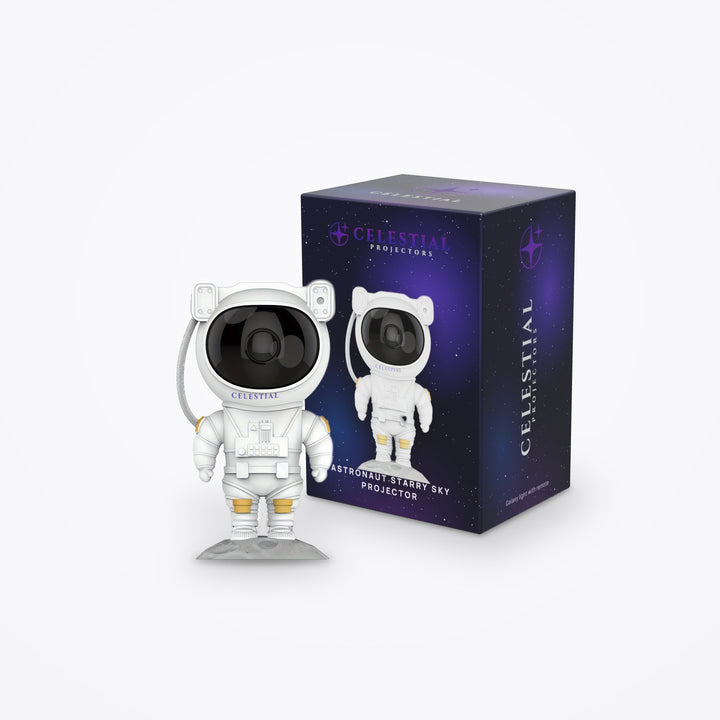
The Astronaut Starry Sky Projector is the standing figure in the lineup, and a standing spaceman has more presence on a shelf than a seated one. It comes with a remote, so you can change the effect from bed. At $39.99 it's the priciest of the five, and what you're paying for is mostly presence: it looks deliberate on a dresser or a nightstand.

Because it stands, give it a flat, stable surface and keep it away from the edge, especially in rooms with pets or small children.
Sitting Astronaut Projector, adjustable
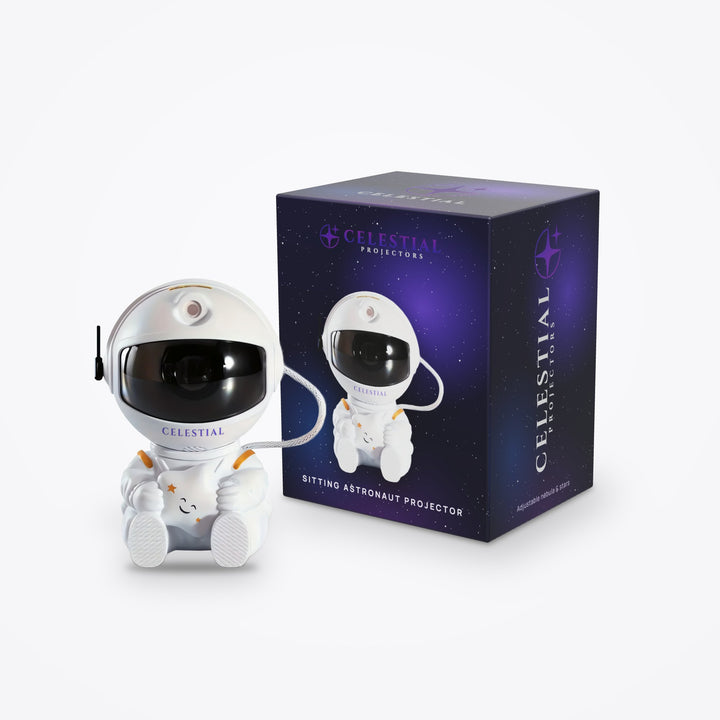
If you care about exactly where the sky lands, start with the Sitting Astronaut Projector. It's described as adjustable, so you can change the projection direction rather than rearranging the furniture. It offers both nebula and star effects, so you can go from a full galaxy to a simpler star field.

Adjustability is especially handy in awkward rooms: a sloped attic ceiling, a bunk bed, or a shelf that isn't in an ideal spot. It's the most flexible of the five for setup.
Astronaut Galaxy Projector with Remote
The Astronaut Galaxy Projector is the value pick. At $28.99, it's the least expensive of our astronauts and still includes a remote, along with star and nebula modes. If you want the spaceman look and remote control but don't need a particular pose, this is the sensible choice.

Astronaut Galaxy Light Projector for kids
The Astronaut Galaxy Light Projector is positioned as a kids' space night light. It's the one to buy when the projector is going into a child's room and the child is the main audience. Pair it with good habits: place it out of reach, set the timer, and keep the cord tucked away. Our guide to the best galaxy projector for a kid's bedroom has more on choosing for children.

Choosing your spaceman
Do you need a remote?
For adults, a remote is close to essential. You'll set the projector up once and adjust it from bed for months. The Standing Starry Sky Projector and the Galaxy Projector with Remote both include one. For the other models, check the listing for controls before buying if a remote matters to you.
Where will it sit?
Sitting figures suit shelves and desk edges, where their legs can hang or rest naturally. Standing figures suit flat tops like dressers. Think about the view, too: you'll see this figure every day, so place it where it looks intentional.
How fussy is the room?
If your ceiling has a fan in the middle, a sloped section, or furniture blocking the obvious angle, the adjustable sitting model will save you frustration.
What's the budget?
The spread is small, from $28.99 to $39.99. Rather than letting price decide, choose the pose and controls you'll be happy with in a year.
Tip: Buying a gift and unsure? The Astronaut Galaxy Projector with Remote is the safest choice: it has the controls most people want, at the lowest price of the five.
Setup tips for astronauts
Astronaut projectors follow the same rules as any projector, with a twist: you're placing a figure and a light source at the same time.
- Place for looks, then check the beam. Set the figure where it looks best, switch it on in the dark, and see where the sky lands. Adjust from there.
- Use distance to control size. As a rule of thumb, roughly 5 to 10 feet from the ceiling gives a full pattern. A spaceman on a dresser in a standard bedroom usually lands in that range.
- Try a corner. Facing the figure toward the opposite upper corner spreads the projection across two walls and the ceiling.
- Keep eyes out of the beam. If a projector uses a laser for its star points, never look directly into the visor while it's on, and don't aim it at a pillow.
- Use the timer. Most astronaut projectors have an auto-off timer. Setting it nightly means the light doesn't run until morning.
For a full walk-through of distance, angle, and room darkness, see our guide on how to set up a star projector.
Care and handling
An astronaut spends its days on display, which means it collects dust like any ornament. A little care keeps both the figure and the projection looking sharp.
- Dust the visor gently. Dust on the lens shows up as a haze or soft spots on the ceiling. Use a dry microfiber cloth or a soft brush; skip household sprays, which can leave a film.
- Move it by the body, not the head. On adjustable models especially, lifting by the helmet strains the joint.
- Give it breathing room. Don't drape anything over the figure while it's running, and keep it away from radiators and sunny windowsills.
- Coil the cable loosely. Tight bends near the plug are where cables tend to fail first.
Our maintenance and care guide covers cleaning and storage for all kinds of projectors in more detail.
Astronaut or standard projector?
An astronaut projector isn't always the right call. A standard dome projector is easier to aim, takes up less visual space, and often offers more settings for the money. Our Galaxy Star Projector with Remote is a good example if you want a plain design.
Choose an astronaut when the projector will be visible during the day and you want it to add something to the room. Choose a standard projector when you want it to disappear. If you'd like real constellations rather than a stylized galaxy, neither is quite right; look at a planetarium model instead, and read our planetarium vs galaxy comparison.
Building a whole theme around the room? Our space-themed bedroom ideas show how to work an astronaut into a wider look, and our gift guide covers who loves them most. Browse the full astronaut projectors collection, or widen the search to all galaxy projectors.
FAQ
Which astronaut projector is best?
For most people, the Astronaut Galaxy Projector with Remote offers the best value: star and nebula effects and a remote at $28.99. Choose the Sitting Astronaut Projector if you need adjustable aiming, the Standing Starry Sky Projector for maximum shelf presence, or the Kids' model for a child's room.
Do astronaut projectors have a timer?
Most do, and an auto-off timer is common across astronaut projectors. Timer lengths vary by model, so check the product listing or manual if a specific timer setting matters to you.
Can you change where an astronaut projector points?
It depends on the model. The Sitting Astronaut Projector is designed to be adjustable. For other models, you aim the projection mainly by where you place and how you turn the figure.
Are astronaut projectors good for kids?
Yes, many kids love them, and we offer a model designed for children's rooms. Place it out of reach, keep the cord tidy, use the timer, and teach children never to look into the visor while it's on.
Do astronaut projectors work on walls as well as ceilings?
Yes. Turn the figure toward a wall, or tilt it on adjustable models. Walls are a good option if your ceiling is heavily textured or has a fan in the middle.