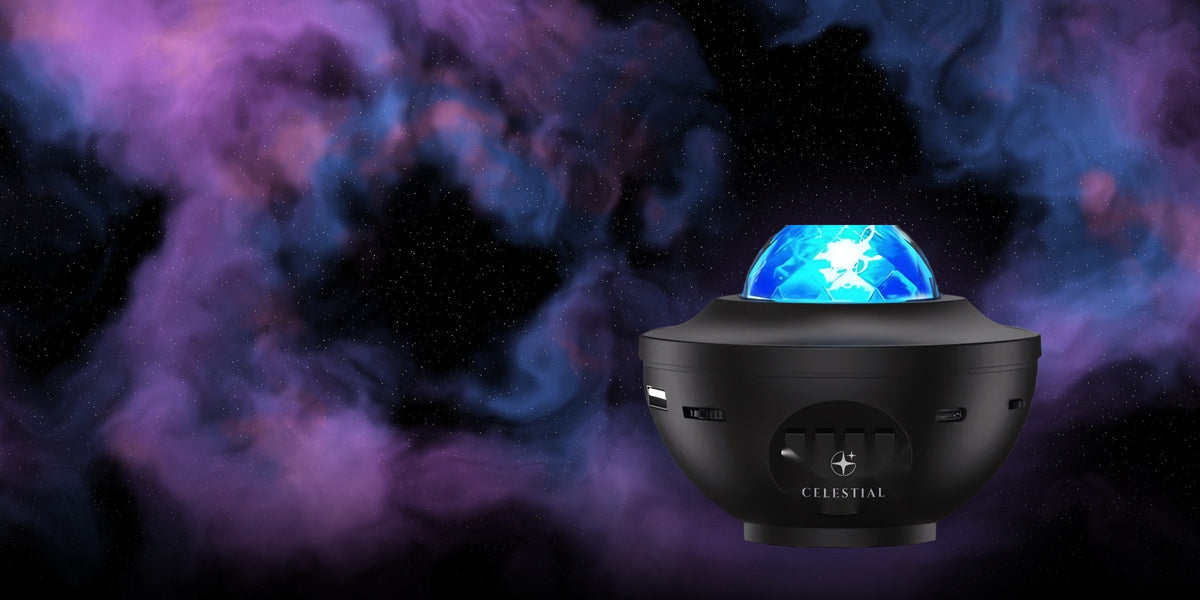
A star projector earns its keep in the ten minutes before you fall asleep. If the pattern is too faint, too busy, or stops short of the corners, you notice, and it ends up in a drawer. Picking the right one depends far more on who sleeps in the room and what they want overhead than on any one spec.
So this roundup is sorted by use case, not by a single ranking. Each pick comes from our own range, and each comes with a plain account of what it does well and what it won't do.
Key takeaways
- Choose by use case first: a child's room, an adult's wind-down, a small space, a realistic sky, or a speaker built in.
- For most bedrooms, a projector placed roughly 5 to 10 feet from the ceiling gives a full, even pattern.
- A remote and an auto-off timer matter more than extra color modes once the novelty fades.
- Disc-based planetarium projectors show real constellations; galaxy projectors trade accuracy for color and mood.
- You don't need to spend a lot: our small-room picks start at $9.99.
How we chose
We looked at every projector in our catalog through the lens of a bedroom ceiling, which is a specific job. A ceiling is usually 8 to 9 feet up, often textured, and seen from a pillow at a low angle. A projector that looks great on a showroom wall can look washed out from bed.
We weighed four things:
- Coverage: whether the pattern can fill most of a typical bedroom ceiling from a nightstand or dresser.
- Control: remote, buttons you can find in the dark, and timers.
- Character of the light: crisp star points, soft nebula clouds, or slow motion like water and aurora.
- Price for what you get: a $10 projector that does one thing well can beat a $40 one with features nobody uses.
We didn't rank on lumens or laser specs. Manufacturers measure those inconsistently, and they say little about how a room actually feels at night.
Quick comparison
| Use case | Our pick | Price | Why it wins |
|---|---|---|---|
| Kids' rooms | Rotating Star & Moon Projector | $21.99 | Simple, friendly shapes and gentle rotation |
| Adults' bedrooms | Galaxy Star Projector with Remote | $29.99 | Nebula clouds plus stars, controlled from bed |
| Small rooms | Starry Night Light Projector | $9.99 | Compact, low-cost, stars and water ripple |
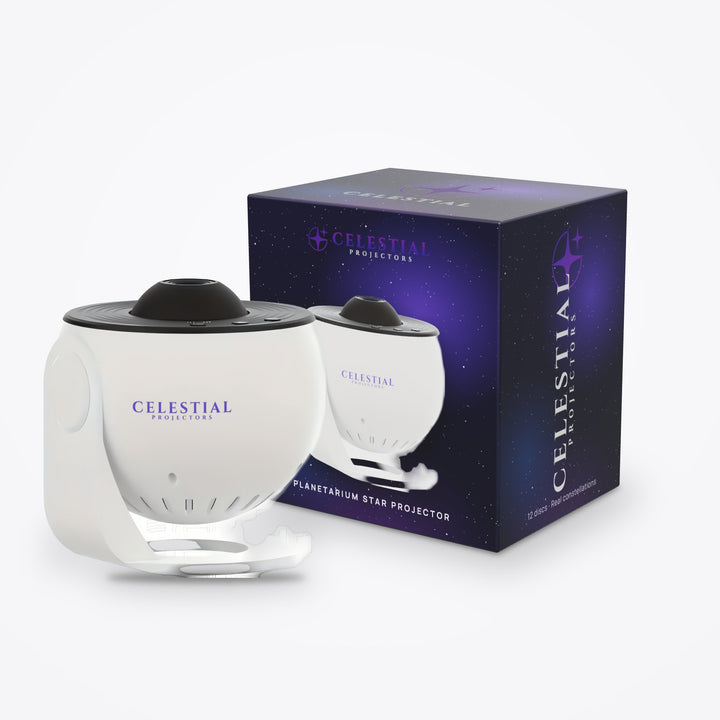
| Realism | Planetarium Star Projector with 12 Discs | $49.99 | Real constellations and planets on swappable discs |
| Sound | Galaxy Projector with Bluetooth Speaker | $70.99 | Speaker built in, light reacts to music |
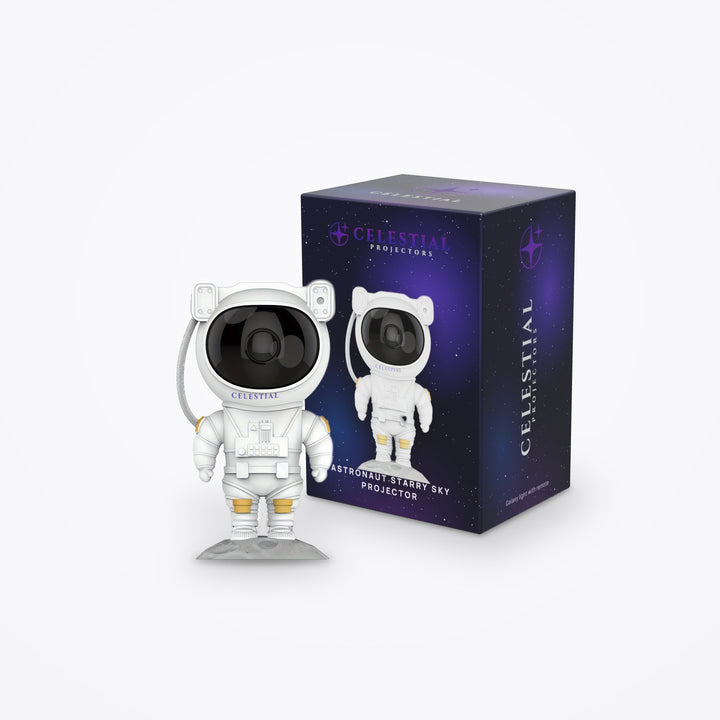
| Decor piece | Astronaut Starry Sky Projector | $39.99 | Standing spaceman that looks good with the lights on |
Best for kids
Children respond to recognizable shapes. A slow-turning field of stars and crescent moons reads as "bedtime" to a five-year-old in a way that an abstract purple nebula sometimes doesn't. That's why our pick here is the Rotating Star & Moon Projector.

The rotation is the point. It gives a child something to watch while they settle, without the color-cycling flash some galaxy modes have. Put it on a dresser across the room rather than the nightstand next to the bed, so little hands are less tempted to fiddle with it at 9 p.m.
If your child is already deep into a space phase, the Astronaut Galaxy Light Projector for kids doubles as a toy-shelf centerpiece. For more ideas by age, see our guide to the best galaxy projector for a kid's bedroom, and browse the full star projectors for kids collection.
Tip: Whatever you choose, use the timer. A projector that switches itself off after your child falls asleep avoids a 2 a.m. argument about turning it back on.
Best for adults
Adults tend to want atmosphere: deep blues and purples, a dusting of stars, and nothing that strobes. The Galaxy Star Projector with Remote covers that brief. It layers nebula clouds with star points, and the remote means you can dim it or switch modes without getting up.
The balance between stars and clouds matters more than you might expect. Heavy nebula modes give a room a warm, enclosed feeling, like a lit tent; star-heavy modes feel more open and airy. Try both on the first night and notice which one you're still enjoying after twenty minutes.
Two habits make an adult setup feel calmer. First, pick one color mode and stick with it on work nights; the cycling modes are fun for guests but restless for sleep. Second, aim the projection slightly away from the bed so the brightest part of the cloud sits over your feet rather than directly above your eyes.
If you want something that also works as decor with the lights on, the standing Astronaut Starry Sky Projector earns its shelf space by day and comes with a remote too. Our longer piece on galaxy projectors for adult bedrooms covers color palettes and room styling in more depth.
Best for small rooms
In a small bedroom, a box room, or a dorm, the ceiling is close and every inch of shelf space is spoken for. A big, bright projector can feel like someone switched on a stage light. Smaller units suit these spaces better, and they happen to be the least expensive.
The Starry Night Light Projector is our pick at $9.99. It rotates a star pattern and also offers a water ripple effect, so you get two moods from one compact lamp. Because the ceiling is close, the pattern stays dense instead of spreading thin.

The runner-up is the Aurora Star Projector at $13.99, which runs on USB and swaps stars for slow northern lights. It's a good fit if you'd rather have flowing color than pinpoint stars. Short on space overall? Our small-space setup ideas cover placement when there's no nightstand.
Best for realism
Most galaxy projectors are impressionistic. They paint a beautiful sky, just not a real one. If you want to lie back and pick out Orion or the Big Dipper, you need a disc-based planetarium projector.
The Planetarium Star Projector with 12 Discs projects real constellations and planets from interchangeable discs, so the ceiling can change from night to night. It's the pick for curious kids, amateur astronomers, and anyone who finds an accurate sky more relaxing than a colorful one.

A good way to start is with one disc per week. Spend a few nights with a single sky, find two or three patterns you can name without checking, then swap. Learning a handful of constellations well is more satisfying than flicking through all twelve discs on the first night and remembering none of them.
Realism comes with one trade-off: disc projectors need a darker room and a moment of focusing to look sharp. If that sounds like a fair deal, read our explainer on planetarium vs galaxy projectors and our new guide to learning constellations with a planetarium projector.
Best with sound
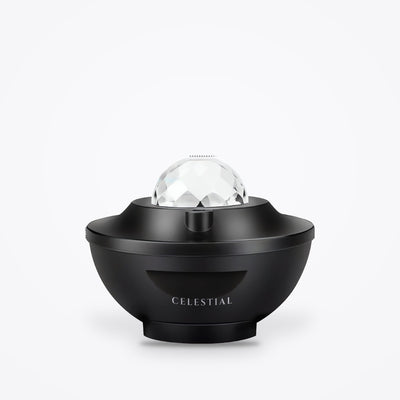
Some people fall asleep to rain sounds, a podcast, or a playlist. If that's you, a projector with a speaker built in removes one more gadget from the nightstand. The Galaxy Projector with Bluetooth Speaker pairs with your phone and has a sound-reactive mode that pulses the light with the music.
Use sound-reactive mode for parties and evenings, not for sleep. At bedtime, switch to a steady light mode and keep the volume low; the speaker works perfectly well as plain audio. It's the most expensive pick here at $70.99, so it makes sense mainly if you'll use the speaker regularly. Otherwise, a $29.99 galaxy projector and the phone speaker you already own will do the job.
How to choose
Measure the distance first
Most projectors look best somewhere around 5 to 10 feet from the surface. Closer, and the pattern is small and bright; farther, and it grows larger and dimmer. If your ceiling is unusually high or the room is large, our guide to matching a projector to room size walks through the trade-offs.
Decide who holds the controls
For an adult, a remote is close to essential. For a young child, fewer buttons is often better, and a parent-set timer does the rest.
Pick a light style, not a feature count
Star points, nebula clouds, water ripples, and aurora bands each create a different mood. Choose the one you'd want on every night. Unsure what the categories mean? Our new explainer on starlight vs galaxy projectors vs night lights sorts it out.
Check the brightness range
A projector that looks vivid at 8 p.m. can feel glaring at midnight once your eyes have adjusted to the dark. Models with adjustable brightness, or a remote that dims in steps, let you turn the sky down as the evening goes on. If a model has only one brightness level, place it a little farther from the ceiling to soften it.
Think about power
USB-powered models are flexible and cheap to run; plug-in models are set-and-forget. Our battery vs plug-in comparison goes deeper. Once yours arrives, our step-by-step setup guide will help you get the best ceiling effect on the first night.
Still deciding? The best sellers and the wider star projectors collection are good places to compare side by side.
FAQ
What is the best star projector for a bedroom ceiling?
It depends on the room. For most adults, a galaxy projector with a remote, like our Galaxy Star Projector, is the best all-rounder. For realistic constellations, choose a disc-based planetarium projector. For a child, a simple rotating star and moon projector is usually the better fit.
How far should a star projector be from the ceiling?
As a rule of thumb, roughly 5 to 10 feet works well for most models. A projector on a nightstand or dresser in a standard bedroom with an 8-foot ceiling usually lands in that range. Closer gives a smaller, brighter pattern; farther gives a bigger, softer one.
Do star projectors work on textured or popcorn ceilings?
Yes, though the stars look softer because the texture scatters the light. Nebula and aurora effects tend to hide texture better than crisp star points. Projecting onto a flat, light-colored wall is an alternative if your ceiling is very rough.
Is it safe to sleep with a star projector on?
Many people do, but we recommend using the auto-off timer so it isn't running all night. If your projector uses lasers for its star points, never look directly into the lens, and keep it out of reach of young children. If you have ongoing trouble sleeping, talk to your doctor.
Are cheaper star projectors worth it?
Often, yes, especially for small rooms. A compact projector close to the ceiling can look as full as a pricier model in a larger room. Spend more when you want specific features, such as interchangeable constellation discs or a built-in speaker.