A planet can appear to pause against the distant stars, move in the opposite direction for a while, then resume its usual course. That sounds like a dramatic change of plans. In reality, the planet has not put its orbit into reverse.
The key word is apparent. We watch from Earth, which is moving too. The changing relationship between our viewing position and another planet can make its path across the background sky look surprisingly complicated.
Separate the orbit from the view
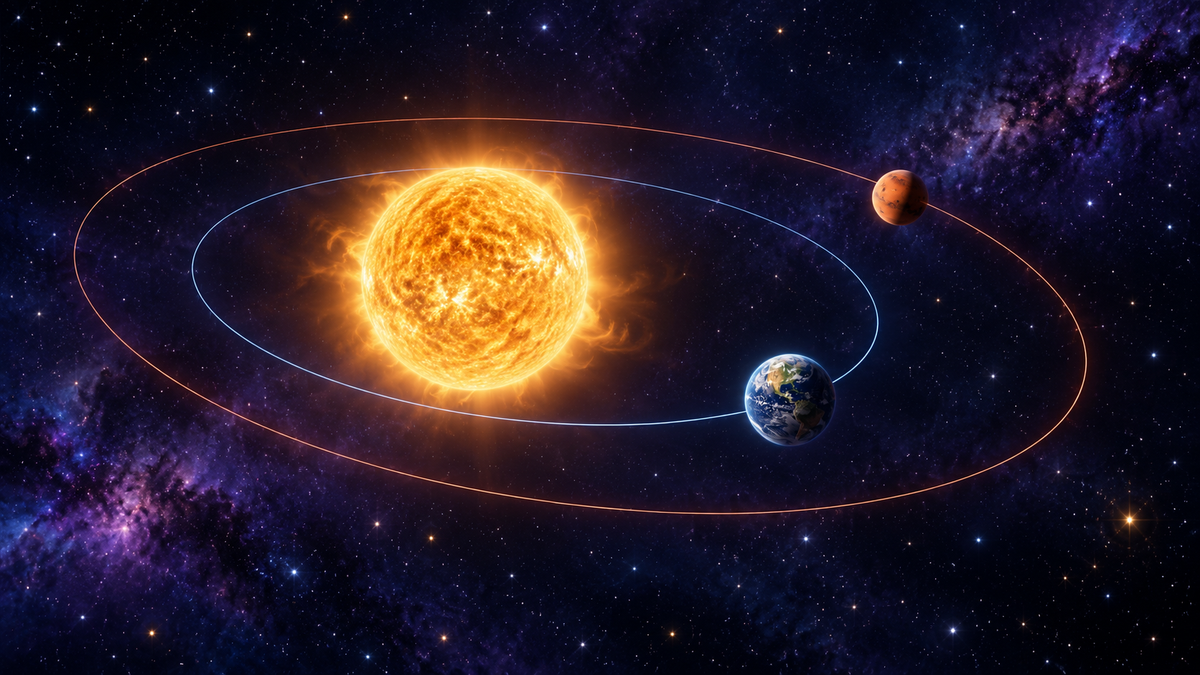
NASA's StarChild explanation of retrograde motion distinguishes an apparent reversal across the sky from a physical reversal of a planet's orbit. The familiar example is Earth catching up with and passing Mars. Both continue around the Sun, but Mars's apparent movement relative to the distant stars changes as our viewpoint changes.
Think of two people walking along neighboring paths in the same direction. As the faster person overtakes the slower one, the slower walker shifts backward in the faster person's view. The slower person has not turned around. The comparison illustrates relative motion, although straight walking paths are not a complete model of planetary orbits.
That distinction is the useful part: an object can change position in your view without reversing its actual direction of travel.
Why Earth can overtake an outer planet
NASA's overview of orbits and Kepler's laws explains that planets follow elliptical orbits and that orbital period is related to the size of the orbit. Earth completes its orbit sooner than Mars completes its larger one. Their relative positions therefore keep changing rather than staying side by side.
The same NASA guide also explains that a planet's orbital speed is not constant around its ellipse: equal areas are swept out in equal times. You do not need to calculate those areas to understand the basic viewing effect, but it is a reminder that a tidy sketch is a simplification.
Keep diagrams and reality in separate categories. Circles, evenly spaced dots and large colored planets make an explanation readable. They should not silently become claims about exact distances, sizes or timing.
Make a two-panel drawing
Try this as a paper activity before looking for a more detailed animation:
- On the left, draw a Sun and two paths around it. Mark the inner path “Earth” and the outer one “Mars.” Write “not to scale” beside the sketch.
- Mark several successive positions on both paths, with Earth advancing farther around its path over the same interval.
- At each stage, imagine looking from the Earth marker toward the Mars marker and continuing that sight line toward a distant background.
- On the right, leave space for the view from Earth. Use NASA's diagram to compare how the apparent direction changes as Earth passes Mars.
Do not worry if a rough first drawing produces an awkward curve. The point is to identify the two viewpoints, not to manufacture an exact astronomical chart. For a precise explanation of the sequence, use the linked NASA diagram rather than treating an improvised sketch as numerical evidence.
Ask better questions about a sky image
When you see a picture of a planet's looping track, check its caption. Is it combining observations from several dates? Which planet does it show? What is used as the background reference? A sequence of positions is different from a single photograph.
Likewise, ask whether an animation is a view from above the solar system or a view from Earth. Switching between those perspectives is educational when the change is labeled. Without that label, it is easy to imagine the planet drawing a little loop in space instead of recognizing a loop in its apparent path.
Save the caption with an image you use for a family discussion. A striking picture separated from its explanation can leave the wrong idea behind.
Keep decorative motion separate from astronomy
A moving galaxy-light pattern is not a simulation of retrograde motion. Its purpose may be atmosphere rather than a model of the solar system. A projected planet image also does not, by itself, show the planet's current position over your home.
Our 12-disc planetarium projector and sitting astronaut nebula projector provide different kinds of room imagery. Read the current descriptions and scene labels, and keep an authoritative astronomy reference nearby when you want to explain a physical process. Do not assume that a decorative effect establishes scientific scale or current sky position.
For an at-home conversation, let the room lighting provide the mood while a separate screen or printed diagram supplies the explanation. One person can describe what the planets are doing; another can describe what the observer sees. If those answers differ, you have found the heart of the topic.
The takeaway: our viewpoint moves too
When an apparent path looks puzzling, ask two questions: where is the object, and where is the observer? Retrograde motion becomes easier to understand once Earth is included in the picture rather than treated as a fixed viewing platform.
This is an evergreen explanation, not a forecast of a retrograde event tonight. For a particular planet and date, consult a current observing reference. The lasting idea needs no special date: motion in the sky is a view of a moving system, seen from inside that system.
Cover: original conceptual illustration of the Sun, Earth and Mars. Sizes, distances and orbital geometry are illustrative, not a scale chart.