A blue light often feels cool in a room, while orange lighting feels warm. Stars offer a useful surprise: in the usual temperature classification, the bluest stars are hotter at their surfaces than the reddest ones. The language of interior lighting and the physics of stars are not describing the same thing.
That contrast makes a good starting point for a space-themed evening. You can use decorative lighting to set the mood while a separate astronomy reference explains the science. Just keep the two roles clear: a projector's color button is not a stellar thermometer.
Start with surface temperature
ESA/Hubble's star reference explains that a star's apparent color depends on its surface temperature. It lists the familiar sequence O, B, A, F, G, K and M, with O-type stars at the hot, blue end and M-type stars at the cool, red end. The Sun belongs to class G.
“Cool” is relative here. It means cooler than other stars in the comparison, not cool enough to approach or touch. Likewise, “surface” is a useful distinction: the classification is not a direct statement of the temperature in the star's core.
When a chart uses a blue-to-red strip, read its heading. Is it showing stellar temperature, a decorative palette, or data assigned to colors? The same colors can carry different meanings in different images.
Do not turn color into a complete biography
Color is informative, but it is not the whole description of a star. NASA's guide to star types describes stars and stellar remnants with very different sizes, brightnesses and evolutionary histories. Its discussion includes main-sequence stars, giants and white dwarfs.
That is why a simple “red means old” or “blue means large” rule is not a reliable replacement for learning which kind of object a source is discussing. Read the name and classification alongside the color rather than guessing a life story from a single picture.
For a family discussion, make two columns on paper: “what the source says” and “what we are guessing.” Put the object's name and stated type in the first. Put questions about its age, size or distance in the second until you find evidence. The distinction is more useful than memorizing a confident but incomplete slogan.
Read the caption before comparing photographs
A telescope image is not always intended to reproduce the view through human eyes. Some images combine observations made through different filters or assign visible colors to data gathered outside the visible range. The caption explains what the displayed colors represent.
Our guide to assigned colors in nebula images explores that separate issue. Do not take a vividly colored nebula, a decorative starfield and a stellar temperature chart as three interchangeable examples of the same process.
Before using a picture in a presentation or a room display, keep its caption and source link with it. An impressive image without its explanation is easy to misread. A short line saying “illustration” or “colors represent these filters” can make the display more educational, not less attractive.
Try a simple sorting activity
Write the seven stellar class letters on individual paper cards. Using the ESA/Hubble reference, arrange them from hotter to cooler. Add blue at one end and red at the other, then place the Sun's G card in the sequence.
Next, make a second row of color choices you might use for a room: blue for a calm-looking scene, amber for a cozy-looking scene, violet for a dramatic one. Notice that these are preferences and associations, not measurements of star temperatures.
Keep the activity on paper or a normal display. There is no reason to look toward the Sun, shine a projector into anyone's eyes or experiment with a device outside its instructions to explain this idea.
Let a starry room remain a starry room
A decorative projector can supply an atmospheric background while you explore the question. The sitting astronaut nebula projector, for example, is described as producing changing nebula colors. That does not establish a scientifically scaled sky map or the temperature of the objects shown.
If you want an educational scene, check the exact image or disc label and pair it with an authoritative reference. Ask which parts are illustrative. A product showing stars or planets is not automatically a simulation of tonight's sky above your location.
The useful takeaway
For stellar classification, blue is the hotter end and red the cooler end. For a photograph, read the caption. For a room projector, read the product's scene description. Keeping those three contexts separate lets you enjoy the colors without asking one image to prove something it was never designed to show.
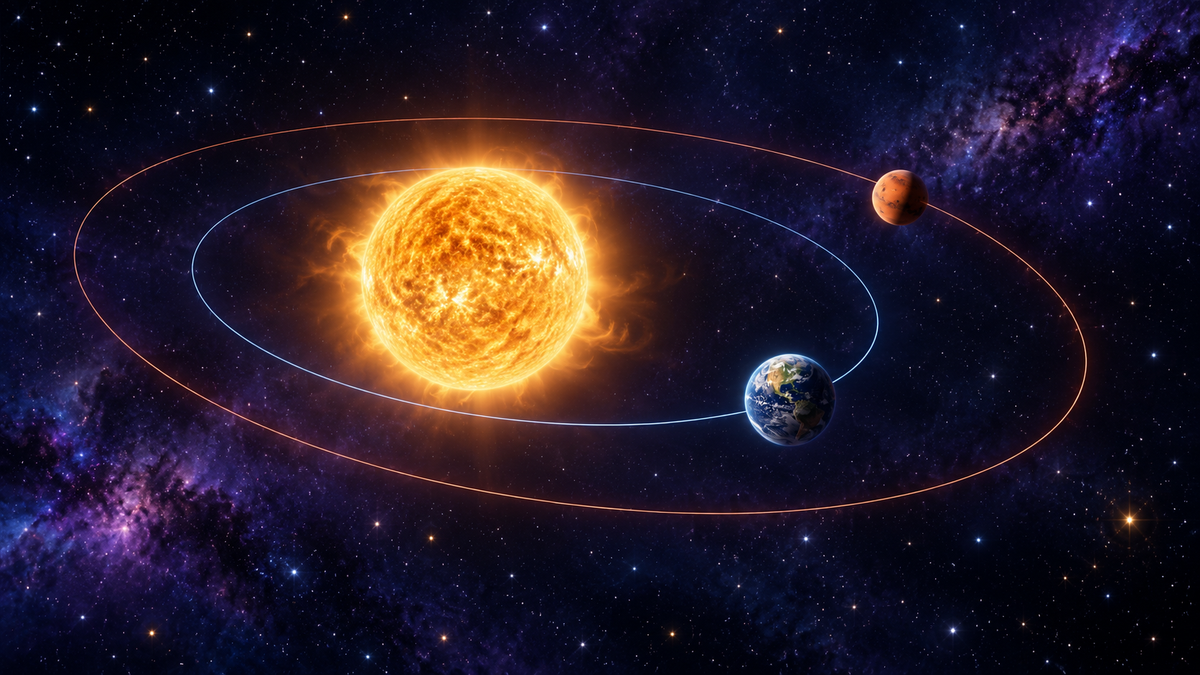
Cover: original conceptual illustration. Star sizes, spacing, textures and colors are illustrative rather than a scale chart or telescope observation.