The Moon seems to present the same familiar face night after night. It is tempting to conclude that it does not spin. The surprising answer is that keeping that face toward Earth requires rotation.
Two motions are involved: turning around an object's own axis and traveling around another object. A small paper model makes the distinction much easier to see than trying to picture both motions at once.
Separate turning from going around
NASA's Moon questions page explains that the Moon completes one rotation in the same time it completes one orbit around Earth. This is called synchronous rotation. If it did not rotate, different sides would face Earth at different points in its orbit.
Start by putting a coin or plain circle of paper in the middle of a table to represent Earth. Use another paper circle for the Moon and draw a dot near one edge. That dot is a marker for one face; it does not need to represent a real crater.
The model is deliberately simple. It does not show actual distances, sizes, orbital tilt or gravity. Its job is to help you keep track of which way one marked face points.
Try the version with no rotation
Choose a wall of the room. Move the Moon circle around the Earth circle while keeping its dot pointed toward that same wall. Keep the paper flat so it is easy to follow. At several positions, pause and look from the central Earth marker toward the Moon.
The dot will sometimes be on the edge nearest Earth and sometimes on the far edge. The Moon marker has traveled around Earth without turning relative to the room, but it has not kept the same face pointed inward.
This is the useful distinction: going around a central object is not the same motion as turning. You can demonstrate one while deliberately leaving out the other.
Now keep the marked face toward Earth
Repeat the trip, this time turning the Moon circle as you move it so the dot always stays on the edge nearest the central marker. Stop at four positions around the table and notice where the dot points relative to the room.
It points toward different walls as you go. By the time you finish the circuit, the paper has turned all the way around once. Yet a viewer at the central Earth marker has kept seeing the marked face.
If you are doing the activity with another person, give them one job: watch the dot, not your hand. Then swap roles. Explaining what stayed the same from Earth's viewpoint and what changed from the room's viewpoint helps avoid the original confusion.
The far side is not permanently dark
“Far side” describes the side turned away from Earth. It does not mean a side that never receives sunlight. NASA's same reference distinguishes the Moon's changing illuminated half from which hemisphere faces us.
Keep that question separate from your rotation model. The dot on your paper identifies a face; it is not a spotlight or a mark for daytime. A drawing can represent several ideas, but it becomes confusing if one symbol silently changes jobs halfway through.
For the lighting question, continue with our guide to Moon phases and eclipses. Keeping rotation, illumination and shadows as separate questions makes each easier to explain.
Use room lighting as a backdrop
A space-themed room can make this a pleasant short activity without making the lighting equipment responsible for the science. A nebula effect is atmosphere. A projected disc is an image. Neither automatically tracks the real Moon's motion or the sky outside your home.
Our 12-disc planetarium projector offers a selection of images according to its current product description. Check what each disc actually depicts and use a separate astronomy reference to explain it. Do not assume a picture is a scale diagram or a live simulation just because it appears on a ceiling.
Keep enough ordinary light on to see the paper activity clearly and follow the projector's instructions for positioning and use. You can enjoy the decorative effect after the tabletop explanation without changing the lesson into an equipment demonstration.
Finish with three questions
- What did the Moon marker do when the dot kept pointing toward one wall?
- What had to change to keep the dot facing the central Earth marker?
- Does a label saying “far side” tell you whether that side is currently sunlit?
You do not need to memorize a long vocabulary list. The central idea is enough: an object can turn once while completing one circuit and still show the same face toward the center. The two motions work together rather than canceling each other out.
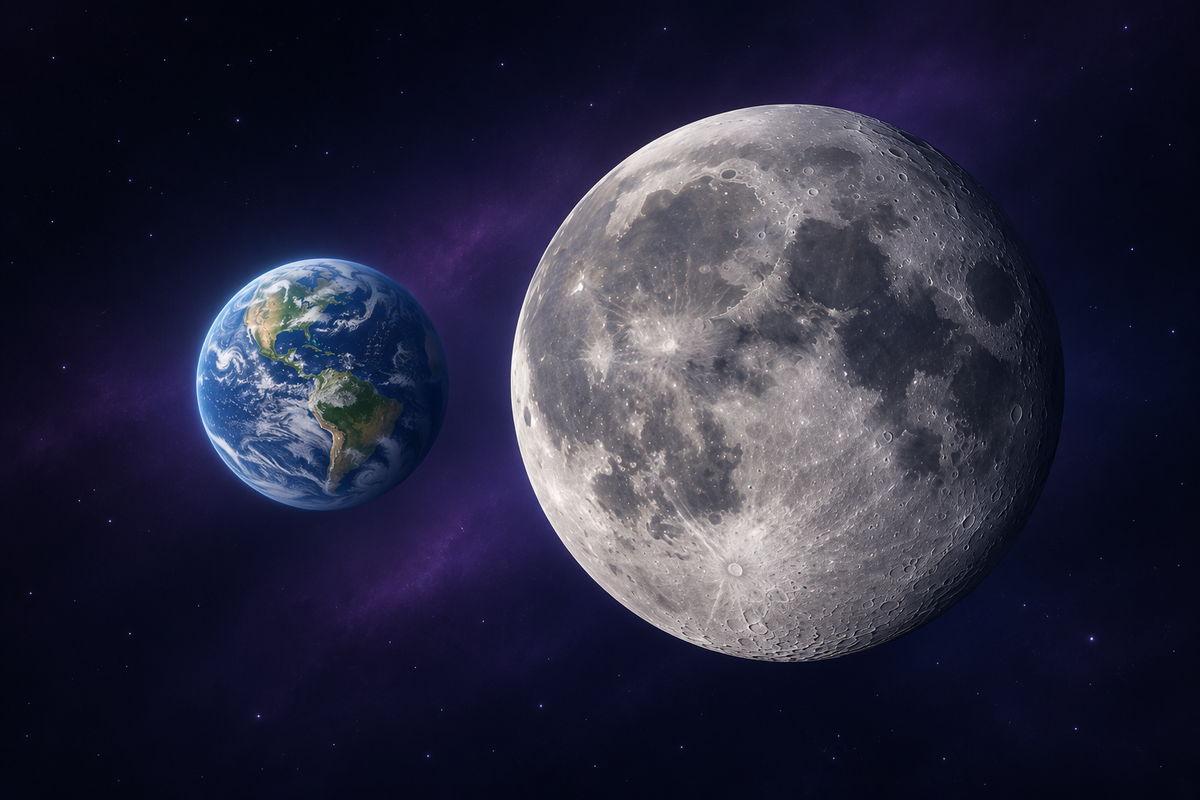
Cover: original conceptual illustration. Relative sizes, distances and surface appearance are illustrative, not a scale diagram or a spacecraft photograph.