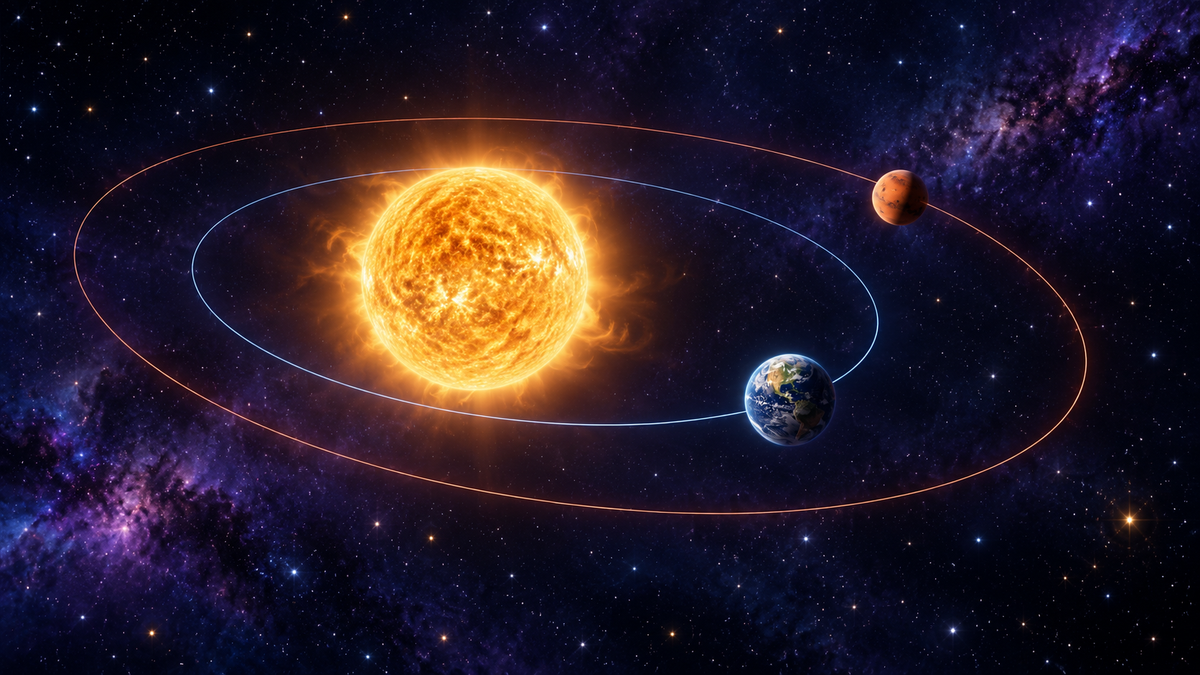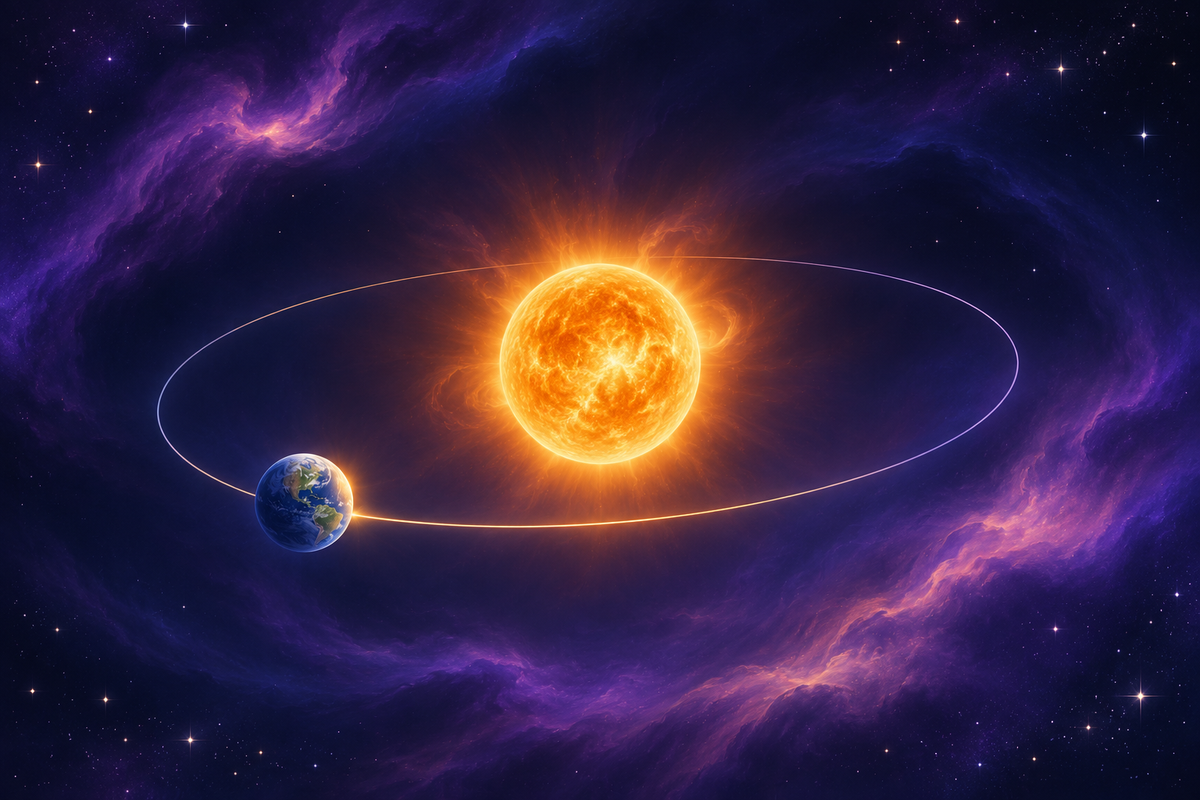
Look outside at the same evening hour in different months and the sky will not be an exact repeat. A familiar star pattern may have shifted toward the horizon, while another now occupies the view. The explanation starts with a change in our viewpoint: Earth travels around the Sun, so the nighttime side of our planet faces different directions through the year.
That idea is easier to understand when you separate three questions: what changes during a single night, what changes from month to month, and what depends on where you live. They are related, but they are not the same observation.
A night is not a year
Earth's rotation changes the direction you face during the course of a night. Earth's orbit changes our position around the Sun during the year. When comparing seasonal views, keep the observation time roughly consistent so you are not mixing a later hour with a later month.
The Chandra X-ray Center's explanation of seasonal constellations describes the nighttime view as looking outward away from the Sun. On opposite sides of Earth's orbit, that outward direction points toward different parts of space. A star pattern associated with the evening sky in one season may be in the daytime direction in another.
The stars have not switched off
The missing pattern has not vanished simply because you cannot see it after dinner. Daylight overwhelms our ordinary view of stars in the daytime sky. Think of a window whose view changes as you move around a room, rather than a display that removes one group of lights and installs another.
This is also why a fixed indoor star pattern should not be treated as a live map of tonight's sky. Decorative effects can be enjoyable without representing the date, viewing direction or location outside. A projected image and a sky chart have different jobs.
Your location belongs in the explanation
NASA Space Place explains that the constellations visible to you depend on both the time of year and your location on Earth. Northern and southern observers do not receive identical views. A seasonal guide written for one hemisphere may therefore be a poor match for another.
Before using a chart, check its intended location, date and time. Also check the direction you are facing. A chart can be correct while the comparison is wrong because you are looking through a different window or toward the opposite horizon. Nearby buildings, trees, clouds and bright surroundings can further limit what is visible from your particular spot.
Try a model with no darkness required
For an indoor demonstration, place a card marked Sun in the middle of a table. Put two different paper star patterns beyond opposite ends of the table. Use a small disk of paper for Earth, and move it from one side of the Sun card to the other. This is a viewpoint model, not a scale model of space.
At each Earth position, draw a little arrow pointing away from the Sun card. Compare which paper pattern sits beyond that arrow. The patterns have stayed in place, but the outward view has changed. You do not need a bright lamp, a laser or a darkened room to demonstrate the idea.
Give the model a limitation note: it leaves out many details, including the observer's latitude and the full three-dimensional sky. Its purpose is to explain one relationship clearly, not to predict which constellation will be above your home on a particular date.
Make a useful observation record
Choose an ordinary safe viewing place and note the date, approximate time and direction. Sketch a few bright points relative to a recognizable feature of the horizon. Record clouds or obstructions rather than filling missing areas from memory. Return on another clear evening, then compare with a later month at a similar hour.
Keep the exercise modest. You are not trying to map the entire sky in one sitting. One carefully described view is more useful than a page of names copied from a chart without checking where they belong. If you cannot identify a point, mark it as unidentified and consult an appropriate current sky guide.
Bring the question into a space-themed room
A room with a projector can be a starting point for these conversations. Ask whether the displayed pattern is decorative, an astronomical image or a date-and-location-based sky simulation. Check the specific product documentation rather than assuming every device called a planetarium provides the same functions.
Explore our planetarium projector collection with that distinction in mind. The useful question is not whether the ceiling looks impressive, but what the image is intended to represent. Once that is clear, you can enjoy the indoor display and understand why the real sky outside keeps offering a different view.