Three bright stars in a row are the easy part of finding Orion. The better prize is the short, fainter row nearby. Look closely at its middle and you may see something that doesn't behave like the stars around it: a small patch of light with soft edges. That's the Orion Nebula, also called Messier 42 or M42.
Start with the Belt, then find the Sword
Orion’s Belt is a line of three bright stars in the familiar figure of Orion. The Sword is a separate, shorter row near it, below the Belt in the familiar upright view. Depending on where and when you look, Orion may be tilted or even appear upside down. Think of the Sword as a shorter row branching away from the Belt rather than looking straight down toward the ground. NASA’s labeled Orion image is a useful reference if you’re unsure which stars belong to which row.
Now look near the middle of the Sword. Under a clear, dark sky, NASA describes the nebula as visible to the unaided eye. You're looking for a soft glow, not a large cloud or a tiny copy of a color photograph. If you can see the Belt easily but the Sword is faint, block glare from nearby lamps with your hand or move to a darker spot. Give your eyes time to adjust to the dark before deciding the Sword isn’t visible.
What binoculars add
If you have binoculars, find the Sword without them first. Keep your eyes on the target while raising the binoculars, then focus on a nearby star until it looks as sharp as you can make it. Move back to the middle of the Sword and compare it with the star you used for focus. The surrounding stars should look more compact than the nebula, even if you can’t trace a clear edge to the glow.
Try bracing your elbows against your body or resting them on something steady. Then lower the binoculars and find the Sword again. Repeating that switch once or twice does more for learning the pattern than sweeping around with the binoculars already up. NASA’s Night Sky Network guide also points out the Trapezium, a compact group of stars near the center of the nebula that you can look for with a telescope. Seeing the surrounding glow is a worthwhile first observation even if you don’t resolve individual stars in the group.
Why it doesn't look like a Hubble image
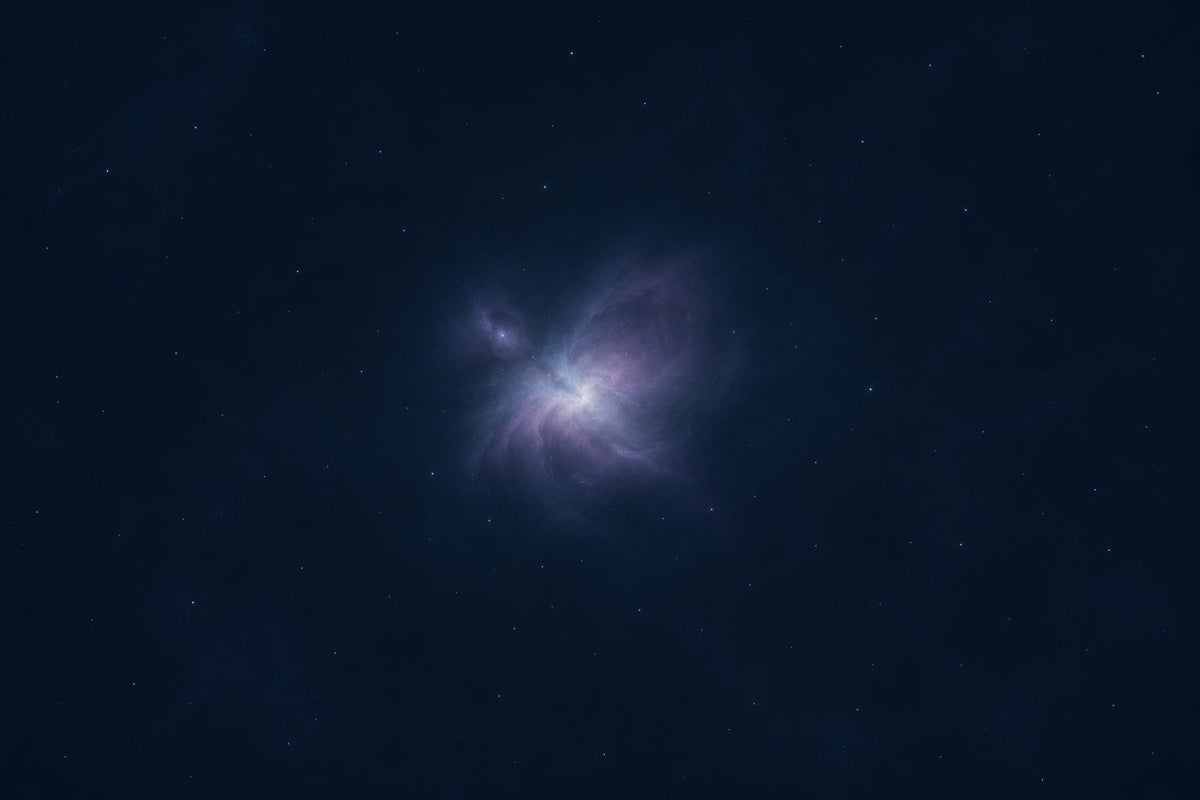
The blur is real, but many published views of M42 bring out details far beyond what you can see at a glance. Long exposures collect light over time. Some images also combine visible and infrared observations, as in NASA’s comparison of the Orion Nebula in visible and infrared light. Those images can tell you more about what's in the cloud, but they aren't a guide to how bright or colorful it should look through binoculars.
The interesting part is what that faint patch represents. M42 is a cloud of gas and dust where young stars are forming. The neighboring stars make a useful comparison: a small patch of sky can contain sharp points of light and the broader glow of a stellar nursery. NASA’s Messier 42 profile shows the same object at a much finer scale.
One thing worth writing down
After looking, record the time and whether you saw the Belt, the Sword or the fuzzy patch, and with what equipment. “Sword visible; middle brighter but not clearly fuzzy” is a useful note. Try again on a clearer night or from somewhere with less nearby glare. The change you’re looking for isn’t a splash of color. It’s the moment you recognize that the middle of the Sword looks different from the stars on either side.
Cover: original conceptual illustration, not an observation photograph or a star chart.